Behaviour Change

PROPAGANDA FOR CHANGE is a project created by the students of Behaviour Change (ps359) and Professor Thomas Hills @thomhills at the Psychology Department of the University of Warwick. This work was supported by funding from Warwick's Institute for Advanced Teaching and Learning.

Sunday, January 19, 2014

Old Spice: The Man Your Man Could Smell Like


Most of you have seen the Old Spice advert above.  The advert was extremely successful, creating long-term media buzz and increasing the sales by 107%. The success of the advert cannot be solely attributed to the bizarreness of the setting and good looks of the man.

To get your attention the advert is featuring a handsome good-smelling man who is contrasted to the man sitting next to you, who smells “like a lady”.  The advert is engaging, giving you suggestive orders “You at me, look back at him…” and together with featuring good-looking man, your perception of low-interest product (such as body wash) is transformed to something more attractive. The advert set the landscape for persuading you to buys the product later on (Pratkanis, 2007).

In Strohmetz et al.’s study (2002), a waiter increased his tips by making the customer feel there is a kind of relationship between them. The waiter either brought over a mint or he wrote a simple thank you at the back of the receipt. This positive affect may have influenced customer’s judgement and increased the tip (Forgas, 1992). The feeling of obligation to reciprocate this little act of generosity is responsible for higher tips (Cialdini, 1993).

Similarly, Old Spice created a personal link between the brand and anyone who commented on the advert on Facebook or Twitter by filming video responses featuring the man from the advert (see the responses here: http://www.youtube.com/playlist?list=PL484F058C3EAF7FA6). Old Spice went out of their way to respond to as many as possible. No one expected them to do these video responses.

The old spice campaign has infringed in normal life inspiring men and women to talk about it. This increased awareness, likeability and together with the feeling of obligation (the man actually replied to your comment) and good landscaping, you are very likely to go and buy Old Spice body wash (Cialdini, 1993; Pratkanis, 2007).


Additionally, there is a link (http://www.slideshare.net/edwardboches/old-spice-case-study-9914721) to the Effie Awards document that describes the aim and outcomes of the advert in more depth.   


Cialdini, R. (1993). Influence (3rd ed.). New York: HarperCollins.

Forgas, J. P. (1992). Affect in social judgments and decisions: A multiprocess model. In M. P. Zanna, (Ed.), Advances in experimental social psychology (Vol. 25, pp. 227275). San Diego , CA : Academic Press.

Pratkanis, A. R. (2007). Social influence analysis: An index of tactics. The science of social influence: Advances and future progress, 17-82.

Strohmetz, D. B., Rind, B., Fisher, R. and Lynn, M. (2002), Sweetening the Till: The Use of Candy to Increase Restaurant Tipping. Journal of Applied Social Psychology, 32, 300–309.


A blog by Bebe
(Alzbeta Husakova)

J'adore


In this glamorous Dior advert the watcher is subjected to a world in which everyone who is beautiful wears Dior. It cleverly portrays Grace Kelly, Marlene Dietrich and Marilyn Monroe, three Hollywood greats, getting ready backstage at a catwalk show. This could be described as a technique known as High Status-Admirer Altercast (Pratkanis, 2007) which takes advantage of how normal people wish to be similar to a prominent and prestigious person, for example by wearing a certain perfume.  Another technique that is used is the Attractive-Admirer Altercast (Pratkanis, 2007), in which others tend to admire attractive people and wish to be part of their world.

At the end of the advert Charlize Theron reaches the end of the catwalk and morphs into the bottle of perfume – same shape, same colour, and even the same neck design. This is an example of association. Smith and Engel (1968) demonstrated this technique when they found that men who saw a car with an attractive female next to it rated the car as faster, more appealing, more expensive and better designed. The men later refused to believe that it was the attractive woman that had influenced their ratings of the car. This technique works when something you like is presented to you with another object, leading you to want that object (Lott & Lott, 1965).

After all, who doesn’t like Charlize Theron?

Stephanie Parsons


Lott, A. J., & Lott, B. E. (1965). Group cohesiveness as interpersonal attraction: A review of relationships with antecedent and variables. Psychological Bulletin, 64, 259-309.


Pratkanis, A. R. (2007). Social influence analysis: An index of tactics. 
The science of social influence: Advances and future progress, 17-82.

Smith, G. & Engel, R. (1968). Influence of a Female Model on Perceived Characteristics of an Automobile, Proceedings of the 76th Annual Convention of the American Psychological Association, 3, 681-682.

Saturday, January 18, 2014

Sheer Cover


In what could only be described as the ultimate mashup of psychological persuasion techniques; this commercial for “Sheer Cover Cosmetics” effectively demonstrates the arsenal of strategies companies have aimed directly at convincing you, the buyer, to surrender your war with logical reason and BUY!

The strength of this ad lies in its use of “social proof”. In psychology, this basically means we use the decisions of others when making our own decisions. The scatter-gun of real life testimonials therefore, not only biases consumers perception of the product to one that is favourable but also inclines them to believe that they will experience similar successful results. Additionally, the use of phrases such as “just like you” is commonplace in advertising because companies want their consumers to identify with people in the ad. Why? Because people more readily empathise and feel positive towards people who are similar to themselves (Escalas & Stern, 2003). The result is the testimonials will have more sway in consumers' final judgement.

The ad sends in a stealth jet to head up the purchasing request “just give it a try”. This is an example of a slightly modified “low-balling” technique (Cialdini et. al., 1978) but with added security. To illustrate, take the Motes (1986) study where shoes were offered at a discounted price to customers. After some deliberation customers agreed to make the purchase, but it was at this point customers were told that the shoes were in fact not on sale. They were then asked if they would still like to buy the shoes at their original price. A surprising 96% of customers said they still wanted the shoes! The Sheer Cover Cosmetics ad uses this same technique, disguising the monetary value of the initial purchase by offering a full refund. In reality customers probably won't ask for their money back because, like the customers in the Motes (1986) study, once people make the decision to buy it becomes a part of their self concept. This is the idea that individuals form their identity though consistent behaviour and the decisions they make. To stick by your purchase therefore, reaffirms your self concept but also reassures you that you made the right choice.

Finally, free-gifts handcuff you to the deal by operating on the basic human principle reciprocity; if someone gives you a gift you feel a need to pay them back (Cialdini & Goldstein, 2004). Here the company 'gave' you all this stuff so you would feel indebted to them, under such circumstances it would be knife to your ego to ask for money back. The solution: keep the makeup, reaffirm your identity as a person, avoid embarrassment and justify your purchase.


References:

Cialdini, R. B., Cacioppo, J. T., Bassett, R., & Miller, J. A. (1978). Low-ball procedure for producing compliance: Commitment then cost. Journal of personality and Social Psychology, 36(5), 463.

Cialdini, R. B., & Goldstein, N. J. (2004). Social influence: Compliance and conformity. Annu. Rev. Psychol., 55, 591-62

Escalas, J. E., & Stern, B. B. (2003). Sympathy and empathy: Emotional responses to advertising dramas. Journal of Consumer Research, 29(4), 566-578.


Motes, W. H., Brown, R. E., Ezell, H. F., & Hudson, G. I. (1986). The influence of "low-balling" on buyers' compliance: Revisited.Psychology & Marketing (1986-1998), 3(2), 79.

It Really Does Get Better


 It gets better. This is a phrase that is said frequently to LGBTQUA+ youth, whilst they are growing up in difficult, and sometimes even life-threatening environments. In 2010, the “It Gets Better Project” was created, as a response to increased numbers of LGBTQUA+ students committing suicide because of bullying. It has now developed into a massive movement, trying to create encouraging messages and positive change for these youth, and also to show them there are others out there who understand what they are going through. With this projects success, it was no wonder a huge company jumped on the bandwagon. Google released the above video as an addition to the campaign, which they then aired during an episode of Glee. This video was met with huge support and managed to go viral. The “It Gets Better Project” itself, has more than 50,000 videos of support, from a huge variety of people. Examples of which are Barack Obama, David Cameron, and Woody from Toy Story.

Lets start by looking at the persuasive message behind the “It Gets Better Project”. When LGBTQUA+ youth watch these videos, they are told that the people on their screens used to be in their position and they should look to them as proof that life does get better. If the person saying this message is one of the regular people who have posted videos, then the principle of similarity is being used. This is when people look at other similar people to make a judgment of their actions. Aune and Basil (2006) showed that people were more likely to donate to a charity, if the person collecting goes to the same university as them. Therefore, if LGBTQUA+ youth were feeling suicidal, then this study would suggest that they would look at others for the correct course of action. But then why would messages from high profile people work? Taylor and Lobel (1989) found that cancer patients look towards people who have overcome their cancer or who have adjusted well to a life with cancer as role models. It was argued that this occurred to fill informational and emotional needs about how to behave positively. So depressed LGBTQUA+ youths would see these videos of people like Neil Patrick Harris, or Ellen DeGeneres and would use them to satisfy informational needs about survival and emotional needs by gaining hope. Projects like the "It Gets Better Project" are important for these reasons. If suicidal youth only see stories about people in situations committing suicide then they are  more likely to follow their lead. Stories of survival and hope need to be made more public so that these suicidal youth can have examples of people who have been through the same situations as them and still gone on to live long and happy lives.

So then, now onto the advert itself. Simonin and Ruth (1998) found that when one brand has a relation to another brand, then attitudes about one could affect attitudes towards another. The Google Chrome advert uses the positive message of the “It Gets Better Project” and the positive feelings of the general public towards the project, and then through association, relates all these positive aspects to Google as a company and Google Chrome. The advert never actually states its views on LGBTQUA+ suicide, or in fact that it had any part in setting up the project. The only relation the advert uses is the suggestion that the project was created on Google Chrome, but yet we are left with a positive view towards Google and the belief that they are helping stop these suicides.

So why would the “It Gets Better Project” want to collaborate with Google? Well, the answer is simple. Google can fund the advert onto primetime television (even if it is during Glee), and so with the increased exposure, hopefully more at risk youth will be able to see it. As well, more possible donators will be able to be reached, therefore hopefully increasing the funding they can get.

Oliver Stoney

References:
 Aune, K., & Basil, M. (1994). A relational obligations approach to the foot-in-the-mouth effect. Journal of Applied Social Psychology, 24, 546-556.

Simonin, B. L., & Ruth, J. A. (1998). Is a company known by the company it keeps? Assessing the spillover effects of brand alliances on consumer brand attitudes. Journal of Marketing Research, 35(1), 30-42.

Taylor, S. E., & Lobel, M. (1989). Social comparison activity under threat: Downward evaluation and upward contacts. Psychological Review, 96, 569-575.

ASOS Urban Tour: An Experiment In Shopping Culture


This interactive online advertisement was presented on a microsite platform within ASOS.com and promoted the autumn/winter 2011 menswear collection for the fashion and beauty website. The microsite no longer exists as part of ASOS, but is viewable via the Bartle Bogle Hegarty (the advertising agency responsible) website http://urbantour.bartleboglehegarty.com/urban-tourIt features extreme examples of raw talent from performance artists across seven countries who are wearing the clothes from the collection. The site allows users to interact by clicking on an individual performer, who breaks out from their group and launches into their own routine, whilst the surroundings remain frozen in time. Users could click to buy products at any point during their viewing experience.

This notion provides a great example of the ‘Interactive Experiment’ creativity template used in advertising as explored by Goldenberg, Mazursky, and Solomon (1999), and in particular the ‘activation version’ of the template. The only way to view the advert was to click onto the microsite and take physical action to interact with it, engaging the consumer.

The Urban Tour website provides an engaging experience for the senses. Research shows that the ‘Interactive’ template of creativity is the most effective compared to other templates used in video advertisements (Roozen & Depypere, 2012).

Interestingly, the ASOS target market of 18-34 is equivalent to the age of the performers featured in the films, which might induce a kind of comparative influence leading people to aspire to be like, and therefore dress like the performers. This idea is supported by Smucker and Creekmore (1972) who found conformity in matters of dress to be an important condition in peer acceptance for adolescents.

For these reasons, ASOS benefited from a creative campaign that enticed users to buy their clothes with one click of their mouse.

Goldenberg, J., Mazursky, D., & Solomon, S. (1999). The fundamental templates of quality ads. Marketing Science, 18(3), 333-351.

Roozen, I., & Depypere, D. (2012). How effective are quality templates of creativity in YouTube campaigns?. ECONOMICS & MANAGEMENT.

Smucker, B., & Creekmore, A. M. (1972). Adolescents’ clothing conformity, awareness, and peer acceptance. Home Economics Research Journal, 1(2), 92-97.

A 20 second behind the scenes video for those interested: 

Other useful links:

Gemma Waters

Friday, January 17, 2014

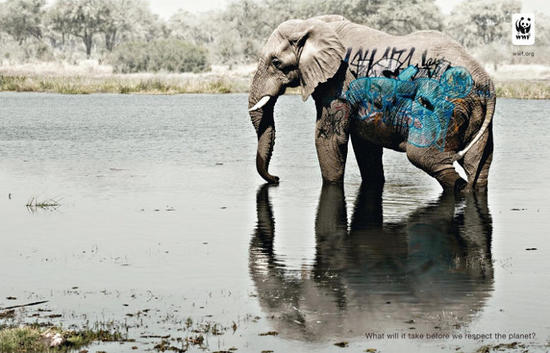
You graffiti'd an elephant. And it's not even good.


This advert created by the WWF (the World Wide Fund for Nature, not the wrestling lot) shows an elephant ‘tagged’ with graffiti. In the bottom right a single line of text reads “What will it take before we respect the planet?”. The top right corner shows the well-known WWF panda logo and website address. The advert combines the concepts of a run-down, un-cared for Coventry-esque urban area with the growing concern of extinction surrounding cute, lovely elephants and other endangered wildlife. The suggestion is that there is no care or respect for Earth’s most vulnerable species and that they are being forgotten and left unsupported by humanity. But, more specifically, you. Bet you can’t even remember the last time you donated to the WWF. You probably did the graffiti. That’s what they’re trying to say, not me.

The visual element of the advert uses the contrast technique (Herr, 1986). The vulgarity of the graffiti is juxtaposed against the elephant which is situated as alone and vulnerable. Who doesn’t love elephants? Who would draw graffiti on an elephant!? Look at that face. The poor thing has been through enough. It doesn’t take much to look favourably upon an elephant but to have such poorly styled graffiti pasted across it by some urban oik is making Dumbo look pretty good in comparison. If it had been a Banksy it might have been okay. Added to the fact that to paint that high on an elephant you would have to park your Ford Ka right up next it, climb on top and then start painting. The elephant just stood there and took it. Poor elephant.

I guess by now you’re feeling pretty guilty? Good. Guilt is very influential in getting you to comply (Carlsmith & Gross, 1969). You’ve probably already got your chequebook out. Some would say we were placed on this Earth to be stewards of everything on it i.e., it is our (see; your) responsibility to look after endangered species. Well someone was slacking if the C0v3ntree Ma55if managed to spray this all over old Nelly here weren’t they?

Finally, what we’re not seeing here are the baby elephants frolicking merrily in the lake just out of shot. Why not? Because good news doesn’t influence you as much as bad news. The WWF have been around for a long time. Surely by now, and with all the money they’ve been given over the years they’ve at least had one successful project and managed to save something. Yes! They probably have! However, if they showed you that picture you’re much less likely to donate because the negativity effect (Hodges, 1974) dictates that bad news will influence you more than good news. It’s “We (you) need to act now” rather than “We (you) need to keep up the good work”.

Contrast.
Herr, P. M. (1986). Consequences of priming: Judgment and behavior. Journal of Personality and Social Psychology, 51 (6), 1106.

Guilt.
Carlsmith, J. M., & Gross, A. E. (1969). Some effects of guilt on compliance. Journal of personality and social psychology, 11  (3), 232.

Negativity effect.
Hodges, B. H. (1974). Effect of valence on relative weighting in impression formation. Journal of Personality and Social Psychology, 30 (3), 378.


James Ulke

Does Tango really make us wild?


This advert by Tango depicts a picture of the product in the top right hand corner of the page with the strapline “Too much Tango causes you to spy on your Mum and Dad when they’re having sex”. The strapline and use of different text size within it immediately catches your attention especially considering the colour contrast between the orange product and green background.

This advertisement uses association. It associates Tango with doing something wild that you wouldn’t ordinarily want to do. It stands out from other adverts because the strapline is outlandish which invites the reader to find out what product would be suggesting this.

The Association Principle is an advertising technique used to influence a consumer’s decision. Gilovich (1981) demonstrated that students who were asked to rate hypothetical footballers on their potential to play professionally were more likely to rate footballers who had irrelevant comparisons with current professionals in their descriptions highly, than control descriptions. By associating Tango with wild behaviour (which also suggests an increase of energy – a key selling point for fizzy drinks) the advert is encouraging the consumer to drink it because they will become wild which is attractive and exciting to consumers.

The use of the word ‘sex’ in this advert is important as it has been found that sex catches people’s attention in advertising (Blair et al., 2006). From the relative size of the word ‘sex’ you can see that they are using it to capture people’s attention. Key (1976) suggests that advertisers use the word ‘sex’ in their prints because of the implicit sexual associations enhance people’s memorability – a clear goal of advertising.

Finally, this advert sets expectations. Pratkanis, Eskenazi & Greenwald (2010) conducted an experiment where participants were either given a self-help tape to help improve memory or to help increase self-esteem. They were labelled as either memory or self-esteem tapes but half of the tapes were wrongly labelled. Results showed that the tapes did not improve memory or self-esteem but participants thought there was an improvement based on the label. Their beliefs had created a reality that did not exist. This advert sets expectations of making you fun, wild and exciting after drinking Tango and even if this does not occur your expectations will create that false reality for you.

In other words, this advert is effective because it exploits our tendency to notice the word ‘sex’, the associations that go with it and our susceptibility to thinking that expectations equal reality. 

Blair, J. D., Stephenson, J. D., Hill, K. L. & Green, J. S. (2006). Ethics in advertising: Sex sells, but should it? Journal of Legal, Ethical and Regulatory Issues, 9(2), 109-118.

Gilovich, T. (1981). Seeing the past in the present: The effect of associations to familiar events on judgements and decisions. Journal of Personality and Social Psychology, 40(5), 797-808.

Key, B. W. (1976). Media sexploitation. Englewood Cliffs, N J: Prentice-Hall.

Pratkanis, A. J., Eskenazi, J., Greenwald, A. G. (2010). What you expect is what you believe (but not necessarily what you get): A test of the effectiveness of subliminal self-help audiotapes. Basic and Applied Social Psychology, 15(3), 251-276.

Eleanor Silk

2010: The Year Politics Became Sexy


2010: The Year Politics Became Sexy


Who is your celebrity crush? Brad Pitt? David Beckham? It may (or may not) surprise you that 10,000 women placed David Cameron as the 92nd sexiest man in the world following a poll by New Woman magazine, putting him ahead of internationally renowned hotties including Russell Crowe and James Blunt. This sex appeal is all too evident in the official advertisement released by the Tories in 2010 as part of Cameron’s (successful) electoral campaign. A clean-cut, airbrushed Cameron is certainly the focal point of this image. But why did this advert really help Cameron win the election? It can’t just be down to those 10,000 women who saw it and thought it would be ‘fun’ to have some eye candy back in number 10... Taking into account the writings of Pratkanis (2007) and Cialdini (2001), one reason to explain Cameron’s campaign success appears in the form of Social Proof.  Cameron created a social relationship between himself and the electorate, enabling him to influence their vote. He did this by using these adverts to make himself appear as a credible source who knew what he was talking about, and could be trusted (whether this remains to be true now is irrelevant). This means that all voters out there, (naturally) wanting to be correct in their decision, could place their trust in this man and assume his view, especially if they had no idea what they were voting for, politically. He appeared to know what he was talking about, and this was enough for us. This led to compliance; thus, more votes for gorgeous, trustworthy Cameron.

But any political leader could do this, so what sets him apart? “We can’t go on like this” highlights the mistakes made by the current party in power, and therefore discredits his opposition as sources, placing Cameron on an even higher pedestal of prestige. Now everyone admires him, some even want to be him so, given this preferential treatment, his power of persuasion increases. He has achieved avoidant miscasting; Cameron has set himself apart from the negative opinions of fellow politicians and paints himself in a positive light, similarly shown in a study by Cooper & Jones (1969), where people changed their beliefs to prevent appearing like an obnoxious confederate.

He proved he knows his stuff and outplayed his opponents in the process. But more needed to be done. Cameron therefore set about increasing his “Plain Folk” image. In a time of financial turmoil, many may turn their nose up at a Public School educated leader with no belief in the state system. Thus in November 2012, he announced that he intended to send his offspring to state schools. We are more likely to be influenced by those we consider similar to ourselves (Brock, 1965; Berscheid, 1966), so by appearing to be just like ‘us’, Cameron has secured another area of persuasion. Thus, a focus on saving the NHS, a system designed for the electorate, plays on this idea of him being like us; what is important to us, is important to him. Perhaps he even uses the NHS. 

Cameron has worked hard to persuade us to vote for him. But regardless of this, it can’t be taken for granted how much easier it is to watch Prime Minister’s Question when it involves the 92nd sexiest man in the world. 

By Louise Lee


Berscheid, E. (1966). Opinion change and communicator-communicatee similarity and dissimilarity. Journal of Personality and Social Psychology, 4, 670-680

Brock, T. C. (1965). Communicator-recipient similarity and decision change. Journal of Personality and Social Psychology, 1, 650-654

Caildini, R. B. (2001). Influence. Boston: Allyn & Bacon

Cooper. J., & Jones, E. E. (1969). Opinion divergence as a strategy to avoid being miscast. Journal of Personality and Social Psychology, 13, 23-30

Pratkanis, A. R. (2007). The Science of Social Influence. NY & East Sussex: Psychology Press