Behaviour Change

PROPAGANDA FOR CHANGE is a project created by the students of Behaviour Change (ps359) and Professor Thomas Hills @thomhills at the Psychology Department of the University of Warwick. This work was supported by funding from Warwick's Institute for Advanced Teaching and Learning.

Thursday, May 3, 2018

SWITCH OFF & WORK!


Motivation

In the modern world, mobile phones allow us to constantly stay connected with our friends, families, check social media, browse news. Whilst being an amazing communication tool, having a mobile phone leads to a certain preoccupation with excessively checking it for updates, which diminishes our ability to concentrate and maintain attention on one task (Carr, 2010; Wajcman & Rose, 2011). This blog post will aim to explore the implications of the presence of a mobile phone while studying, as well as consider what can be done to avoid distraction and increase productivity. 

The phenomenon of distraction by phone is especially prevalent amongst students. A study by Robers, Yaya and Manolis (2014) discovered that male college students spent 8 hours per day using their mobile phones, whilst female college students spent almost 10 hours. Furthermore, the results of a 500-student sample questionnaire have demonstrated that 73% of students are unable to study without technology in general and 38% cannot resist not checking their devices for a period longer than 10 minutes (Kessler, 2011).

These findings have been supported experimentally by Rosen, Carrier and Cheever (2013), who showed that students were unable to study for more than 6 minutes before switching to technology. Another more recent survey by McCoy (2016) has shown that students spent almost 21% of time in class using their mobile phone for non-class related purposes. In addition, the same research has shown that there has been an increase since 2013 to 2015 in the average number of times a phone was used in a school day – from 10.93 to 11.43, indicating that the severity of this issue is on the rise.

Such findings should definitely be a cause for concern, and students should seek to decrease the distractions caused by the phone. This excessive use of phones and inability to focus when studying can have serious repercussions for productivity and time management. For instance, those students who were texting while doing a reading comprehension task required more time to finish it than those who were not (Bowman, Levine, Waite, & Gendron, 2009; Fox, Rosen, & Crawford, 2009).

Phone distraction can also negatively impact academic performance itself, as frequent text messaging and using social media is correlated with lower grades (Harman & Sato, 2011; Walsh, Fielder, Carey, & Carey, 2013).  Moreover, Rosen, Lim, Carrier and Cheever (2011) conducted an experiment where students were asked to watch a lecture, the understanding of which would later be tested. They were split into three conditions based on the number of text messages each group would receive: none, 4 or 8. Those who received the highest number of text messages performed significantly worse than the non-interrupted participants. Hence, texting in class and when revising can infringe upon the quantity of information recalled.

In order to see whether students at the University of Warwick are concerned with their level of procrastination, an informal poll via Facebook was conducted, the results of which are shown in Figure 1.
                                                                                                                    
Figure 1. Results of an informal poll on phone procrastination at Warwick.
       
We found these facts highly disturbing and wanted to raise awareness about the influence of procrastination on academic attainment and, most importantly, provide a way for students to control their procrastination. One of our main aims is to show that, even in such a hyper-connected world, it is vital to have the ability to switch off and work with no distractions.

Action and persuasion techniques implemented

Step 1: Contacting the Study happy team

In order to encourage students to use their phone less whilst studying, we decided to collaborate with the ‘Study Happy’ team at Warwick, who primarily focus on the students’ wellbeing. As we knew that it would be hard to convince the Student Wellbeing officer, we decided to use the door-in-the-face technique to convince her. We approached her with the request of asking more than we expected to get from her – to install phone lockers on every floor of the library. As they had already allocated funds for the year, she was extremely hesitant. We then presented the idea of holding a ‘phone free’ event as a concession to installing lockers. She agreed to hold the event, because our request drew on the reciprocity rule, as she felt obliged to reciprocate a concession (Cialdini, 2009). This technique has been previously tested by Cialdini et al. (1975), who wanted to convince a group of students to take a group of delinquents on a trip to the zoo. Compliance rates were much higher in the condition where this favour was preceded by a larger request to spend 2 hours per week as counsellors to the same offenders for a minimum of two years.

With the event date in place, our two main aims were to get students to come to our event and promote the importance of switching off their phones to students who can’t make it to the event.


Step 2: Promoting the event

Since our target audience is students, we made a poster that was distributed in paper form around lecture theatres and shown on all the main library TV screens, as shown in Figure 2 and 3. By doing so, we increased students’ familiarity with the phrase “Switch off & work!”. An increase in familiarity through mere exposure leads to attraction and influence the decision making of students to attend the event and reduce procrastination (Hekkert, Thurgood, & Whitfield, 2013). This effect was supported by Zajonc (1968) when he exposed his English-speaking participants to unfamiliar Chinese ideographs. The results demonstrated that students rated the characters to have a positive meaning when they saw them more frequently. With an increase in familiarity, we hope that students would have a more positive impression of the phrase and thus sign up online when they see the “Switch off & work!” event being promoted.

A Facebook page (https://www.facebook.com/events/1258452980924811/ , Figure 4) was also created and was shared by the Warwick library. This increased the audience reached as well as the liking of the event, as the library is seen as a familiar and trustworthy brand to the students. As seen from an advertising study using television ads and computer internet ads done by Campbell and Keller (2003), repetition of advertising attributed to a known, familiar brand was more effective compared to an unfamiliar brand.  

Additionally, we used the scarcity technique with the ‘LIMITED SPACES AVAILABLE’ sign on the poster and the number remaining available spots were stated on the signup page. The scarcity principle is the idea that people value items, that are limited in numbers, much more than abundant resources. The effect of limited supply has been shown in a study by Worchel, Lee and Adewole (1975), on the cookie jar experiment. Participants were asked to rate the attractiveness of the cookies that were either in an abundant or limited supply. It was found that though both jars of cookies are similar, the near-empty jar was valued more. Hence suggesting that with the limited supply of seats available, students are more likely to be attracted to register for the event so to not miss out on it.

In order to sign up to the event, students had to actively register by clicking a link and entering their details. We thought this would ensure that they would attend the event as they have made an active commitment. The effectiveness of this technique is supported by an experiment by Allison & Messick (1988), who asked students to volunteer for an AIDS education project by either actively filling out a form or passively stating that they are not wishing to participate. Results showed that 74% of the people who were in the active commitment condition attended the project.

Figure 2. Promotional poster

Figure 3. Promotional poster displayed on TV screen on floor 2 of the library
Figure 4. Facebook page advertising the event

Step 3: Educational poster

Not only was the aim of this project to promote the phone free event but also to educate students on the harm of phone procrastination. We did so by creating a poster (Figure 5) and putting it up around the university campus, as shown in Figure 6.

We used a variety of persuasion techniques when designing it, as we wanted to ensure that the maximum level of attitude change is achieved. We referred to the Elaboration likelihood model (Petty & Cacioppo,1986) in order to choose which persuasion route, we wanted to resort to. Firstly, if a person has the motivation to attend to the information or it is personally relevant to them, they will focus on the information presented to them and will not be fooled by simple advertising tricks. This has been tested by Petty, Cacioppo & Goldman (1981), who gave undergraduate students a list of arguments for introducing comprehensive exit exams. They manipulated the personal relevance of the argument by suggesting that the changes will be implemented before their graduation (relevant) or after (irrelevant). Results have demonstrated that when it was not personally relevant to the students, they were persuaded by the expertise of the presenter. However, when the personal relevance was high, students ignored the presenter and focused on the coherence of the argument. This directly applied to our issue, as phone procrastination is a personally relevant issue to the majority of the students, especially during exam time. Hence, we resorted to the central route of persuasion. It suggests that when people care about the issue, the information in the advertisement will be put under scrutiny and will only be able to change the attitude of the reader if it is coherent and the content of the message is of high quality (Petty & Hinsenkamp,  2017).  Therefore, we used research evidence in order to communicate the negative impact phone procrastination can have on educational attainment. However, the clarity and the fluency of the argument can enhance the ability to understand it, as sometimes, even when the information is personally relevant, the cognitive resources available for processing may be limited, infringing on the ability to process the content. This motivated us to state the research results in simpler language so that anyone can understand it without putting much effort in. Not only did we increase the fluency of the message but also implemented the use of rhetorical questions, as according to Burnkrant & Howard (1984) they motivate more thorough processing of the message. This hopefully increased the understanding of the issue in the reader.

Furthermore, in order to increase the clarity of the message and hence the understanding we resorted to using natural frequencies when communicating the research to the students by saying that ⅖ students can’t resist their phones instead of 40%. The use of natural frequencies rather than percentages makes the information more intelligible and easier to understand. The use of natural frequencies has been previously supported by Alk et al. (2011) when studying ways of reporting medical risk. In that study, participants were presented with the same risk in either natural frequency, percentages or relative risk format. It was found that people understood the risk of a health outcome better when it was presented as a natural frequency. Hence by presenting the risk of being a victim of phone procrastination during work to the students in the form of natural frequency, they would be able to understand the outcome better.

Furthermore, we used the ‘foot-in-the-door’ technique, which implies that people are more likely to comply with a big request after they have already complied with a smaller request. For example, in the Freedman and Fraser study (1966), the experimenters initially requested to install a small sign in people’s backyards, which increased their compliance to later install a large sign. In our poster, we asked a small favour to put phones away for just an hour, to then increase the probability of students attending our event.

Figure 5. The educational poster


Figure 6. The educational poster in front of the library

Step 4: The ‘switch off and work’ event

The event took place in the library teaching grid on the 1st of May, lasting from 11am to 3pm. Around 30 students attended the event out of 40 spaces available. They were seated as shown in Figure 7. When designing the event, we initially suggested storing the phones of the participants for the duration of the event. However, for security reasons, this was not allowed by the Library and we referred to the power of authority and public commitment persuasion techniques in order to encourage the students to put their phones away.

The event coordinator, who gave the instructions to put the phones away for the duration of the event, was dressed in a library uniform. This attire is associated with authority, which students feel obligated to comply to. Bickman (1974) has demonstrated that it is much harder to resist a request when it comes from an authority figure. In order to test this, random people on the street were asked by a confederate dressed in either civilian, milkman or guard attire to pick up a paper bag. The compliance rates were the highest when the requestor was dressed as a guard.

Instead of asking students to put their phones in their bags, they placed them into an envelope during the event and sealed it. Putting their phone in the envelope is considered to be a public commitment to refrain from checking notifications. The effectiveness of this technique was supported by Deutsch & Gerard (1955). The experiment asked the participants to either write down an estimate of the length of line shown to them and after handing their answer in; writing it down privately; or keeping it in their head. It was found that participants who made a public commitment were the most loyal to their answer while those who did not write it down at all were the least loyal. In addition, if they decided to tear the envelope in front of everyone, it would attract everyone’s attention, putting them at risk of being perceived as a weak-willed individual who failed to stick by their commitment during the event. Since people want to look like a consistent person who sticks to their commitment (Tedeschi, Schlenker, & Bonoma, 1971), they would think twice before tearing the envelope.


Figure 7. Event

After our event, we wanted to get students to preserve the behavior of studying without their phones. Hence, we gave everyone participating a flyer with information on how to reduce phone procrastination that they could refer to (Figure 8). Additionally, we asked all the attendees to write down how they will make sure they will use their phone less whilst studying, as Gollwitzer (1999) has shown that concretely deciding what, when and how you will do something greatly increases the likelihood of further actions.


Figure 8.  Flyers with tips how to stop procrastination


Measuring behaviour change

●      The educational poster was placed outside the library in the smoking area. Thousands of people pass that spot every day, which exposed them to the information.

●      Furthermore, 40 spaces were available at the event and 30 people attended it. None of them checked their phones during the event. Students said that they did not realise how much the presence of a phone impacted their performance and managed to massively increase their productivity.

●      We have also influenced the action of the Study happy team, as they have considered running this event on a permanent basis because it was so successful, as shown in the email below.

●      Overall, we believe that we managed to increase awareness about mobile phones being a significant distraction and hopefully caused some long term behaviour change.


By Daria Ovcharenko, Yun Shiuan Lau and Daria Vlasova

References:

Akl, E. A., Oxman, A. D., Herrin, J., Vist, G. E., Terrenato, I., Sperati, F., Costiniuk, C., Blank, D., & Schünemann, H. (2011). Using alternative statistical formats for presenting risks and risk reductions. Cochrane Database Syst Review, 3.
Allison, S., & Messick, D. (1988). The Feature-Positive Effect, Attitude Strength, and Degree of Perceived Consensus. Personality and Social Psychology Bulletin, 14, 231-241.  
Bickman, L. (1974). The social power of a uniform. Journal of Applied Social Psychology, 4, 47-61.
Bowman, L. L., Levine, L. E., Waite, B. M., & Gendron, M. (2009). Can students really multitask? An experimental study of instant messaging while reading. Computers & Education, 54, 927–931.
Burnkrant, R. E., & Howard, D. J. (1984). Effects of the use of introductory rhetorical questions versus statements on information processing. Journal of Personality and social psychology, 47, 1218.
Campbell, M. C., & Keller, K. L. (2003). Brand familiarity and advertising repetition effects. Journal of consumer research, 30, 292-304.
Carr, N. (2010). The shallows: What the internet is doing to our brains. New York, NY: Norton.
Cialdini, R. (2009). Influence (5th ed.). Boston: Pearson Education.
Cialdini, R. B., Vincent, J. E., Lewis, S. K., Catalan, J., Wheeler, D., Darby, B. L. (1975) A reciprocal concession procedure for inducing compliance: The door-in-the-face technique. Journal of Personality and Social Psychology, 31, 206–215.
Deutsch, M., & Gerard, H. (1955). A study of normative and informational social influences upon individual judgment. The Journal of Abnormal And Social Psychology, 51, 629-636.  
Deutsch, M., & Gerard, H. B. (1955). A study of normative and informational social influences upon individual judgment. The Journal of Abnormal and Social Psychology, 51, 629-636.
Fox, A. B., Rosen, J., & Crawford, M. (2009). Distractions, distractions: Does instant messaging affect college students’ performance on a concurrent reading comprehension task? CyberPsychology & Behavior, 12, 51–53.
Freedman, J. L., & Fraser, S. C. (1966). Compliance without pressure: the foot-in-the-door technique. Journal of personality and social psychology, 4, 195.
Garbett, G., & Milgram, S. (1975). Obedience to Authority: An Experimental View. Man, 10, 167.  
Gigerenzer, G., & Edwards, A. (2003). Simple tools for understanding risks: from innumeracy to insight. BMJ, 327, 741-744.  
Gollwitzer, P. (1999). Implementation intentions: Strong effects of simple plans. American Psychologist, 54, 493-503.  
Harman, B. A., & Sato, T. (2011). Cell phone use and grade point average among undergraduate university students. College Student Journal, 45, 544–549.
Hekkert, P., Thurgood, C., & Whitfield, T. A. (2013). The mere exposure effect for consumer products as a consequence of existing familiarity and controlled exposure. Acta psychologica, 144, 411-417.
Kessler, S. (2011). 38% of college students can’t go 10 minutes without tech [STATS]. Mashable Tech. <http://mashable.com/2011/05/31/college-tech-device-stats/>.
McCoy, B.R. (2016). Digital Distractions in the Classroom Phase II: Student Classroom Use of Digital Devices for Non-Class Related Purposes. Journal of Media Education, 7, 5 – 32.
Milgram, S., Liberty, H., Toledo, R., & Wackenhut, J. (1986). Response to intrusion into waiting lines. Journal of Personality and Social Psychology, 51, 683-689.  
Petty, R. E., & Cacioppo, J. T. (1986). The elaboration likelihood model of persuasion. In Communication and persuasion (pp. 1-24). Springer New York.
Petty, R. E., Cacioppo, J. T., & Goldman, R. (1981). Personal involvement as a determinant of argument-based persuasion. Journal of personality and social psychology, 41, 847.
Petty, R. E., Cacioppo, J. T., & Schumann, D. (1983). Central and peripheral routes to advertising effectiveness: The moderating role of involvement. Journal of consumer research, 10, 135-146.
Petty, R.E., & Hinsenkamp, L. (2017). Routes to Persuasion, Central and Peripheral. In The SAGE Encyclopedia of Political Behavior (pp. 718-720). Thousand Oaks: SAGE Publications, Inc.
Roberts, J., Yaya, L., & Manolis, C. (2014). The invisible addiction: Cell-phone activities and addiction among male and female college students. Journal of Behavioral Addictions, 3, 254-265. 
Rosen, L., Carrier, L., & Cheever, N. (2013). Facebook and texting made me do it: Media-induced task-switching while studying. Computers in Human Behavior, 29, 948-958.  
Rosen, L., Lim, A., Carrier, L., & Cheever, N. (2011). An examination of the educational impact of text message-induced task switching in the classroom: Educational implications and strategies to enhance learning. Spanish Journal of Educational Psychology, 17, 163-177.
Tedeschi, J. T., Schlenker, B. R., & Bonoma, T. V. (1971). Cognitive dissonance: Private ratiocination or public spectacle? American Psychologist, 26, 685-695.
Tedeschi, J., Schlenker, B., & Bonoma, T. (1971). Cognitive dissonance: Private ratiocination or public spectacle?. American Psychologist, 26, 685-695.  
Wajcman, J., & Rose, E. (2011). Constant connectivity: Rethinking interruptions at work. Organization Studies, 32, 941–961.
Walsh, J. L., Fielder, R. L., Carey, K. B., & Carey, M. P. (2013). Female college students’ media use and academic outcomes – results from a longitudinal cohort study. Emerging Adulthood, 1, 219–232.
Worchel, S., Lee, J., & Adewole, A. (1975). Effects of supply and demand on ratings of object value. Journal of Personality and Social Psychology, 32, 906-914.
Zajonc, R. B. (1968). Attitudinal effects of mere exposure. Journal of personality and social psychology, 9, 1.

Smoking Kills: Persuading University of Warwick students to stop smoking on campus

For our behaviour change project, we created a video with the primary goal of persuading individuals, particularly university students to quit smoking. The motivation behind this was that it might lead to a reduction in smoking on campus.  The goal of this project was not aimed at implementing a smoking ban policy on campus, but rather to persuade individuals who do smoke on campus to quit. As a group, we felt that the incentive of decreasing smoking was a particularly important cause. A report in 2016, published by the Health & Social care information centre whom collaborate with the NHS, reported that younger adults were more likely to smoke than older adults. This report stated that 25% of 16-34 year olds considered themselves to be smokers and 20% of adults in the UK were likely to smoke on a daily basis (See Figure 1). Furthermore, it was reported that adults with higher levels of qualifications were less likely to smoke. This being said, it was still reported that individuals in the UK completing higher education before receiving a degree,  as much as 15% of this target group were still likely to be smokers.


Figure 1 – Taken from Statistics on Smoking, published in 2016. Health and Social Care Information Centre.


Smoking in public places may have detrimental long-term health effects on non-smoking University students. The NHS states that long-term exposure to second-hand smoke can increase the likelihood of contracting lung cancer by 20-30% and coronary heart disease by 25-30%. To emphasise the harmfulness of second-hand smoke, a 50 year report in the U.S., conducted by the U.S. Department of Health and Human Services predicts that an alarming figure of 2,500,000 non-smokers have died from health problems caused by exposure to secondhand smoke in the U.S. since 1964. It could, therefore, be presented as a strong argument that persuading individuals to reduce the frequency or to refrain from smoking in high capacity areas on campus is justifiable. It has been suggested that the majority of lifelong smokers begin smoking before the age of 24 (Missouri, 2016), thus making university students a high target audience for tobacco companies to convince students to take up the habit of smoking. A study by Levinson et al. (2008) commented that smoking is considered a social activity at University for those who partake in it. This is particularly worrying, as a social activity that has connotations of harmless behaviour may have detrimental long-lasting health issues. For example, the NHS in 2014 released figures that estimated around 1.7 admissions to hospital over 2014-2015 were due to ailments that are likely to have been caused by smoking. This is an alarming 4.7 thousand admissions each day! Moreover, the NHS also estimated that in the year 2014, around 78,000 deaths in the UK were attributed to smoking.  

Our project consisted of a video that was uploaded to YouTube (seen below) and was also shown on the big screen in the Piazza of Warwick campus for a week up to the 29th April. The incentive behind uploading our video to YouTube was to allow wide-scale accessibility to view our video.  Demographics for YouTube (seen in Figure 2) show that the highest age range of users who access YouTube were individuals in the age range 18-34. These figures emphasise the importance of utilising a media platform to upload our video that will reach University students. This is particularly important when coupled with the Health & Social care information centre’s report, which stated that almost 25% of 16-34 year olds were considered to indulge in smoking behaviour. The motive behind using the big screen in the popular location of the University piazza was an attempt to target Warwick university students directly. Firstly, the piazza is often one of the busiest areas on campus; thus allowing our video to be viewed by a larger amount of students, rather than it being uploaded solely to YouTube, Facebook or other social media platforms. Secondly, the goal of the project was to try and promote a change on University campus. The use of the big screen allowed our message in the video to be conveyed directly to University of Warwick students. Therefore, it could be argued that this approach may lead to having a bigger impact on reducing the number of individuals that smoke on campus. Thirdly, the piazza is considered a highly social location on campus, whereby many students meet to engage in conversation or engage in group activities. In light of research by Levinson et al. (2008), that suggests smoking amongst University students is considered a social activity, the use of a social location on campus to convey the video’s message seemed highly appropriate. 


Some factors were implemented to ensure that the issue being addressed was conveyed to the target audience in mind. Firstly, the video was filmed on campus, in locations that would have been highly identifiable by the majority of students at the University of Warwick. Secondly, the video consisted of dialogue in English, Spanish and Urdu. The foreign languages were accompanied with English subtitles. The motive behind the incorporation of multiple spoken languages within our video was based on many premises.  Firstly, Warwick University has been named as one of the world’s top 20 most international universities (Times Higher education). The foreign languages spoken in the video may have been directly targetable to some University students, thus incorporating the international aspect that Warwick University has been rated so highly for.  However, the use of foreign languages was not to specifically target Spanish or Urdu speakers. In fact, the use of multiple languages served as a message to collectively unite as a highly international University to reduce smoking on campus. This message was conveyed in the video. 


Figure 2. 


There were a variety of persuasion techniques that were implemented in our video to assist in the goal of the project, which was attempting to persuade Warwick students to reduce smoking on campus.


Loss Aversion

Loss aversion is a central conclusion from the study of risky choices. It refers to an underlying tendency we all have, whereby people prefer to avoid losses than to acquire similar gains (Tversky & Kahneman, 1991). People hate losing. For example, this persuasive technique was used in a simple experiment. In the experiment, half of the class were given coffee mugs, and other half did not receive a mug (Thaler & Sunstein, 2008). Mug owners were later invited to sell these mugs and nonowner to buy them. They did this by answering the question “at each of the following prices, indicate whether you would be willing to give up your mug/buy your mug.” Findings showed that mug owners were demanding around twice as much to give up their mugs than others were willing to pay for (Thaler & Sunstein, 2008). This show that people do not assign value to objects, but rather when they have to give something up, it hurts them more than acquiring the same thing (Thaler & Sunstein, 2008).

We tried to persuade others to change their behaviour and decrease their smoking habits by using loss aversion in the video. We hoped that by explicitly telling students about all the money they would be able to save throughout their lifetime (around £90,000), would encourage them to at least decrease the level of smoking. This way we were not only supporting students to lead a healthier lifestyle but also to realise that all the money they are spending on tobacco could be better spent elsewhere. Students have many expenses, and even by decreasing their smoking habits, they would be able to cut down and save more money.


Attribution effects / Manded altercast

Attribution effect is a tactic for persuading people by attributing certain desirable or undesirable characteristics to people who perform a specific behaviour. This persuasion technique was used in several experiments by Bryan, Adams, and Monin (2013) to prevent undesirable behaviour. The study tested whether highlighting the identity consequences of cheating would cause people to be honest. Participants could claim money which they were not entitled to, at the experimenter’s expense (Bryan, Adams, & Monin, 2013). Instructions of the task participants had to complete were subtly manipulated by referring to cheating with language that would either highlight the implications of cheating for the participant’s identity (e.g. “Please don’t be a cheater”) or would focus more on the action (“Please don’t cheat”). Participants who were assigned to the “cheating” condition demanded more money than those in the “cheater” condition, who showed no evidence of cheating expense (Bryan, Adams, & Monin, 2013). The findings show how powerful subtle changes in linguistic can be in preventing unethical behaviour by appealing to people’s desire to maintain the self-image as honest (Bryan, Adams, & Monin, 2013).

Similarly, in the video, we highlighted the identity consequences of smoking to try and cause people to stop or decrease their smoking habits. By using subtle changes in linguistics, such as, “don’t be a smoker”, we hoped to prevent smoking by appealing to people’s desire to maintain a self-image of being healthy.


Framing Effects

Framing effect is a cognitive bias whereby people react differently to the same choice depending on the context. Information about a health behaviour like smoking can be presented in a gain frame for example “you will live longer if you quit smoking” or a loss frame “you will die sooner if you don’t stop smoking” (Toll et al., 2007). An obtained gain for decreasing smoking behaviour can be framed as “you prolong your heart and lung life” or an avoided loss for decreasing smoking behaviour can be framed as “you don’t shorten your heart and lung life” (Tasso, Monaci, Trentin, & Rosabianca, 2005). According to Prospect theory, making gains salient leads to loss averse behaviour whereas making losses salient leads to risk-seeking behaviour (Tverksy & Kahneman, 1981). 

There is mix research as to which frame is more effective. A study on high school students suggested that loss framed warnings on cigarette packages decreased smoking-related behaviour and increased intentions to reduce smoking levels (Goodall & Appiah, 2008). Keeping in line with that, our video included loss framed facts about how others will find you unattractive due to your smoking habits. However according to Prospect theory, making losses salient leads to risk-seeking behaviour (Tverksy & Kahneman, 1981). Indeed in another study on college students, gain framed messages significantly decreased smoking behaviour, which was sustained for 6 weeks (Schneider et al., 2001). Keeping in line with that, our video included gain framed facts like how decreasing smoking will save your life, other’s life and your money as well. Thus, in the video for our project, we thought that one way to decrease the smoking behaviour might be by strengthening the link between smoking and its associated desirable and undesirable identities.


Social proof

Bandura’s (1986) Bobo doll experiments introduced social cognitive theory. These studies suggested that the observation of others behaviour can result in a similar change of behaviour within the observer. This action is known as a heuristic in the form of social proof. For example, a study by Weaver, Miller, Garcia, and Schwarz (2007) demonstrated that hearing the same message from one person three times was as persuasive as hearing the same message from three different people. In our video, the message “smoking kills” was repeatedly mentioned throughout, in order to try and emphasise the detrimental associations of smoking, in an attempt to persuade individuals to quit. Even after all the research explaining the adverse health problems associated with smoking, it may seem strange as to why such a high percentage of individuals still smoke on a daily occurrence. In fact, it is likely that many smokers were influenced to start smoking as they may have modelled it from parents and friends. This is particularly relevant when the availability heuristic (Tversky & Kahneman, 1973) proposes that the ease of retrieval of an event is an indicator of its relative frequency in the environment and thus its importance. 

In regards to our study, Cialdini (2007) states a particularly relevant point, mentioning that school based anti-smoking programs had lasting effects only when it used same-age peer leaders as teachers. Therefore, the individuals whom featured in the video were group project members, individuals that are active members of the University’s community and are of similar ages to the majority of University students. Social proof and other persuasion techniques outlined above, were incorporated into our video to express the detrimental factors associated with smoking, coupled with the beneficial aspects of quitting smoking in an attempt to persuade individuals to reduce smoking on campus. 


To conclude, our project aimed to reduce smoking behaviour on Warwick University campus. We decided to take this step by uploading a video on the Big Screen in the piazza, as well as on YouTube. We used different persuasive techniques in our video, rooted in the principles of loss aversion, framing effects and social proof. It may have been beneficial to question University students as to whether they saw the video presented on the Big Screen and if indeed these persuasion techniques resulted in any viewer being less inclined to smoke on campus. This would allow us to determine whether our project reached its target audience, as well as deciding whether more work (e.g. posters around campus, giving talks on the risks associated to smoking...) should be implemented in addition to our project, to persuade students to smoke less on campus.


Areeba, Sofia and Thomas


References

Bandura, A. (1986). The explanatory and predictive scope of self-efficacy theory. Journal of Social and Clinical Psychology, 4, 359-373.

Bryan, C. J., Adams, G. S., & Monin, B. (2013). When cheating would make you a cheater: Implicating the self prevents unethical behavior. Journal of Experimental Psychology: General, 142, 1001-1005.

Cialdini, R. B. (2007). Influence: The psychology of persuasion. New York: Collins.

Goodall, C., & Appiah, O. (2008). Adolescents' perceptions of Canadian cigarette package warning labels: Investigating the effects of message framing. Health Communication, 23, 117-127.

Health and Social Care Information Centre. (2016). Statistics on Smoking, England. Hscic, 2-39.

Levinson, A. H., Campo, S., Gascoigne, J., Jolly, O., Zakharyan, A., & Vu Tran, Z. (2007). Smoking, but not smokers: Identity among college students who smoke cigarettes. Nicotine & Tobacco Research, 9, 845-852.

Medicine. Missouri (2016). Research reveals when and why students smoke in effort to help them quit.

Schneider, T. R., Salovey, P., Pallonen, U., Mundorf, N., Smith, N. F., & Steward, W. T. (2001). Visual and auditory message framing effects on tobacco smoking. Journal of Applied Social Psychology, 31, 667-682.

Tasso, A., Monaci, M. G., Trentin, R., & Rosabianca, A. (2005). Frame effects in persuasive messages against smoking. In Annual Conference of the Cognitive Science Society, Stresa, Italy.

Thaler, R., & Sunstein, C. (2008). Nudge: Improving decisions about health, wealth and happiness. London: Penguin Books.

The Health Consequences of Smoking—50 Years of Progress: A Report of the Surgeon General, 2014. U.S. Department of Health and Human Services.

Toll, B. A., O'malley, S. S., Katulak, N. A., Wu, R., Dubin, J. A., Latimer, A., ... & Salovey, P. (2007). Comparing gain-and loss-framed messages for smoking cessation with sustained-release bupropion: A randomized controlled trial. Psychology of Addictive Behaviors, 21, 534-544.

Tversky, A. & Kahneman, D. (1973). Availability: A heuristic for judging frequency and probability. Cognitive psychology, 5, 207-232.

Tversky, A., & Kahneman, D. (1981). The framing of decisions and the psychology of choice. Science, 211, 453-458.

Tversky, A., & Kahneman, D. (1991). Loss aversion in Riskless choice: A reference-dependent model. Quarterly Journal of Economics, 106, 1039-1061.

Weaver, K., Miller, T. D., Garcia, M. S., & Schwarz, N. (2007). Inferring the popularity of an opinion from its familiarity: A repetitive voice can sound like a chorus. Journal of Personality and Social Psychology, 92, 821-833.


Warwick for Ecosia

Warwick for Ecosia
The Problem
In contemporary culture there are an abundance of pressing concerns ranging from sexual harassment to racial profiling, and everything in between (matters that should have, and should be, addressed more directly). Whilst these issues are of undeniable significance, the issue of climate change should not be pushed under the rug. It is a pivotal issue in current times, and is a major threat to everyone sharing this planet. Despite its prevalence, and potentially disastrous consequences it remains an frequently understated issue, with cognitive biases often leading to climate change being ignored, or downgraded in its urgency. In fact, only 32% of American voters rated global warming as a ‘very important’ factor in their candidate’s stance, and 39% for protecting the environment (Leiserowitz et al, 2014). Despite less than half of American voters prioritizing the prevention of climate change, the threat is growing exponentially.
The need to restore more than two billion hectares of lan (Wri.org, 2018) highlights the issues that climate change, particularly deforestation, can cause. Most obviously, deforestation removes a major source of absorption of greenhouse gases (Nationalgeographic.com, 2018). Other effects are wide ranging: loss of habitat for both humans and non-human animals; soil erosion; change in vapor flows. Deforestation for commercial reasons creates a threat to the 1.6 billion people who rely on forest habitats for their jobs and homes (Fao.org, 2018).
This is where Ecosia can be introduced. Ecosia is a free browser extension which takes (from personal timed experience) less than 15 seconds to install. This organisation donates 80% of its profits to non-profit conservation organisations. Along with many commendable qualities such as financial transparency, the most attributed work of the organisation is focused on trees. Tree planting programmes are the predominant focus of Ecosia; a tree is planted every 30 seconds through programmes funded by their ad-revenue. Environmental and social benefits are intrinsically linked to the tree-planting programmes.Therefore, the use of this search engine has all-pervasive effects.
With the internet being so easily accessible to Warwick students, and our collective scope for reaching a wide number of Warwick students, we decided Ecosia would our project focus. In 2017, 46.8% of the global population accessed the internet, with 1.2 trillion searches per year worldwide on Google (Smart Insights, 2018). On average, 45 searches on Ecosia equates to the planting of a tree. Theoretically, if these searches were all made on Ecosia, this would have meant the planting of around 26, 666, 666, 700 trees! The difficulty in competing against such a strong market leader as Google is not ideal, but we hope our campaign will help change enough people’s behaviour to make a considerable difference. If we were able to persuade 100 people to change their default browser to Ecosia, say they make 10 searches a day, that would equate to the planting of roughly 8111 trees.

What We Did
Posters


Stall
We also set up a stall outside the library where we handed out tote bags with the Ecosia logo on. While handing out these bags we gave people a flyer explaining in detail what Ecosia is and why they should use it.


Persuasion Techniques
Foot-in-the-door
Our campaign made use of the foot-in-the-door technique, which works by asking a small request initially, with the aim of securing a larger favour later (Freedman & Fraser, 1966). Respondents are unwittingly changing their behavioural direction by agreeing to smaller requests, characterised by the term “successive approximations”, or “shaping. (Skinner, 1953). Freedman and Fraser (1966) explain the phenomena by linking it to self-perception and interpreting their actions (Bem, 1972). The bond created in the first small request gives way to a likelihood to agree to a larger request to keep their behaviour consister. As a result of shifting attitudes (forming the conclusion they like the requester) they justify why they undertook the first request and so agree to the second request for the same reason.
Freedman and Fraser (1966) demonstrated foot-in-the-door in their study, where they induced compliance to a larger request by preceding it with a smaller one. Participants were approached initially and asked if they would display a small sign promoting safe driving- nearly everyone agreed to it. Later, they were asked to allow a large billboard to be installed in their front garden, reading ‘Drive Carefully’. 76% of participants agreed to have this sign in front of their house, while 83% of people who hadn’t been asked the small request refused. This illustrates how by getting your foot in the door, you can persuade people to agree to a much larger request. An example of this technique within the environmental field, similar to our project, is Meineri and Guéguen’s (2008) naturalistic application, promoting the Econ’Home project. Participants were either given a questionnaire over the phone and then a flyer asking them to take part in the campaign, or just the flyer. Those in the experimental condition were 31% more likely to agree to take part in the campaign.
We implemented foot-in-the-door through our Facebook page (‘Warwick for Ecosia’). We initially asked people to just ‘like’ the page in support of Ecosia. This action shows commitment from the user who is ‘liking’ the Facebook page, which results in compliance to a larger request – asking people to change their default search engine to Ecosia. This is because people like to be consistent in their views and beliefs (Cialdini, 2007). When we ask people to change their default search engine to Ecosia, they will remember that they previously supported this cause, and so will be more likely to agree to the request to appear consistent in their self-image. Additionally, this technique was implemented through our tote bags, as we first asked people if they would take a bag, and then went on to to ask them to change their default search engine.
Social Proof
Social proof in advertising is the idea that people refer to social norms when making decisions about their own behaviour in order to be liked and accepted (Cialdini, 2007). Social proof has routes in the social learning theory which is where an observer imitates a model’s behaviour. We were able to implement this process within our Ecosia campaign. By advertising through the social media platform Facebook individuals were able to see their friends liking and reviewing the page. There were a total of 91 likes and 9 5-star reviews; peers demonstrating a positive attribution towards the company is likely to be influential to others within the ‘in-group’.
Furthermore, we distributed tote bags on campus. Seeing other students engaging with, and promoting Ecosia, suggests Ecosia to be a socially acceptable company. It is also likely for people to attend more to something that is part of a social norm- this taps into conformity where one seeks to be like the ingroup they are a part of.
Mere Exposure
Another persuasive technique we used in our campaign is mere exposure. This is the concept that by repeatedly exposing individuals to something, their attitudes towards it will be enhanced (Zajonc, 1968). Through our posters, flyers, tote bags, and Facebook page, we have repeatedly exposed the Ecosia logo and name to individuals in the hope that their attitudes towards it will be enhanced. This should eventually lead to more people changing their default search engine to Ecosia.
One study providing evidence of the success of the mere exposure effect was conducted by Pliner (1982). Subjects were exposed to different fruit juices either 20, 10, 5 or 0 times. It was found that the juices that had been tasted the most frequently were rated as the most liked.
Fang, Singh, and Ahluwalia (2007) suggest that the mere exposure effect is related to fluency. Repeatedly exposing individuals to something increases its fluency, and research has shown that we prefer things which are fluent (Reber, Winkielman, & Schwarz, 1998). Therefore, we hope that our repeated exposure of Ecosia will cause it to become more fluent and so will result in enhanced attitudes towards it. This should lead to more people using Ecosia and setting it as their default search engine.
Just Ask
It has been found that the simple concept of just asking for help is surprisingly successful (Bohns & Flynn, 2010). Think back to the times where someone has come up to you for some change, or to fill out a survey. You have no obligations to them, yet find yourself wanting to fulfill their request and feel bad if you do not. This has been found consistently despite people underestimating how much others would be willing to help by up to 50% (Flynn & Lake, 2008) .
The classic study referred to when talking about this concept is Clarke and Hatfield’s (1989) campus study. They found 56% of women were willing to go to dinner with a stranger, and 75% of men were willing to go to bed with a stranger! In our campaign we utilised the just ask policy throughout. We asked people to like our page; we asked the Ecosia Country Manager for resources and to do a talk at the uni (both requests being fulfilled); and, most importantly, we asked people to use Ecosia. We asked people in our posters, our flyers, on our social media page, and in person.
Commitment/Consistency
Cialdini (1984) identified commitment as one of his 6 major principles of persuasion. This essentially claims once someone has made a public commitment to a cause, they are more likely to follow through on the commitment, as a function of wanting to be consistent. People adjust their attitudes so as to justify their behaviour and reduce cognitive dissonance, such as the liking of a Facebook page would lead to them believing in the cause the page is promoting (Festinger & Carlsmith, 1959). Public commitment as identified by the term itself, is letting the world know what you believe in. One of the most well known examples of the commitment principle is in Knox and Inkster’s (1968) observations of people at racetracks. People were more confident in a horse after they had placed a bet on it, despite odds being the same. They were acting more consistently with their behaviour by believing the horse is more likely to win.
This principle links to others we used, such as just ask and foot in the door- it is fairly easy to get people to take a tote bag or like a page, so attaining a small piece of commitment from people will greatly aid people to actually switching their browser to Ecosia.
The social media is a good example of public commitment- it is on their profile and people can see the likes on the Ecosia page.
We got people committed by liking the page or stopping to look at the posters or tote bags at our stall, and then used this commitment to get them to change their browser.

ELM
Peripheral Route
People often cannot devote their full attention to each message that they are exposed to, which is where the peripheral route comes in. The peripheral route is the idea that people base the strength of an argument on cues other than the content i.e. attractiveness/similarity of the messenger, and production quality (Petty and Cacioppo, 1986).
One heuristic is similarity of messenger, students are more likely to be influenced due to a sense of belonging and similarity to a student run campaign i.e. if we stand for it, and we are part of the in-group, then it may seem sensible for them to follow this pattern of behaviour. Furthermore, we distributed tote bags provided for us by Ecosia themselves, credibility can also be used as a heuristic in the peripheral route as it gives gravitas to an argument, and with authority being another heuristic, Ecosia as a source of messenger is likely to increase the influence of the campaign to the audience even further.
Another aspect of the peripheral route is the production quality of the campaign, having  a Facebook page, posters, flyers, and tote bags, represents a campaign that is pro-active, efficient, and engaging, traits audience members use the peripheral route will go on to assign to Ecosia itself.
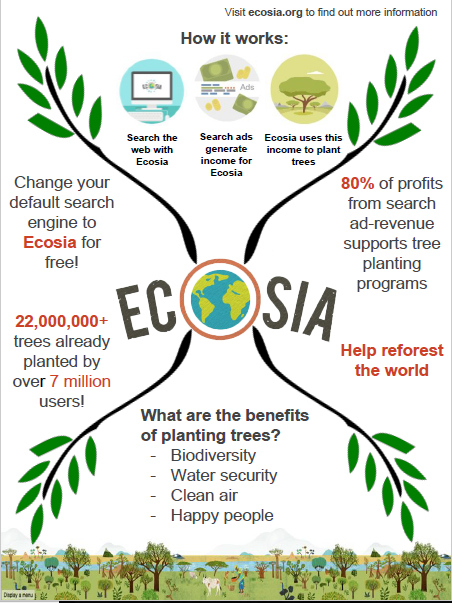
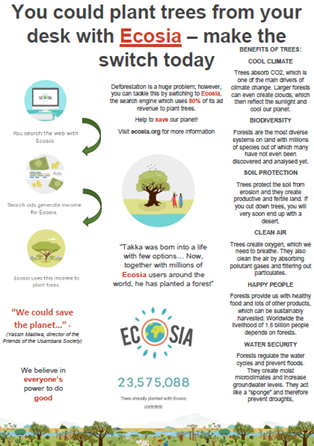
The campaign had a theme of nature throughout with the posters, flyers, and Facebook cover photo all containing images of trees, animals, and greenery. This depiction of nature thriving alongside the search engine Ecosia connects the two, potentially leading people to attribute Ecosia with a thriving natural environment. This is particularly exemplified with the poster, where tree branches are coming out of the ‘o’ in Ecosia, highlighting the fact that Ecosia is the source of a blossoming and growing process for the environment.
Central Route
Attitude changes through the central route tend to last longer and are more predictive of behaviour then the peripheral route (McNeil & Brien, 1989), so it was important for us to target this route as well. The central route is used when the recipient has enough motivation and the ability to process the content of the message (Petty and Cacioppo, 1986), with environmental concerns becoming increasingly prevalent (Reynolds, Bostrom, Read & Morgan, 2010) , it is likely many recipients will be using this route. The central route relies on facts and so we included statistics in the flyers and posters such as “80% of profits from search ad-revenue supports tree planting programs” and “22,000,000+ trees already planted”.
Conclusion
Attempting to change people’s behaviour regarding climate change is a challenge. Human’s cognitive biases may not identify the issue as salient due to lack of obvious exposure to climate change, other phenomena such as a fire for example, may be deemed more salient due to the obvious danger it can pose. By eliciting so much public engagement with the issue via the platform Ecosia, our project demonstrates that even issues that may be initially less salient, can be influenced using persuasive techniques, by engaging the peripheral and central routes, using social influence, foot in the door techniques and so on. The importance of raising awareness, and encouraging positive engagement in the prevention of climate change is undeniable. It is a concrete, indisputable issue that our project has helped to raise awareness of. Although our project found successful results, the tackling of climate change is an ongoing process. For this reason, we intend to give this project some future investment- the Country Manager from Ecosia has agreed to give a talk at the Uni, an exciting prospect we hope we will be able to achieve.

Sarah Snow, Katy Males, and Hannah Long
References
Bem D. J. (1972). Self-perception theory. In L. Berkowitz (Ed.), Advances in experimental social psychology (pp.1-62). New York: Academic Press.
Bohns, V. K., & Flynn, F. J. (2010). “Why didn’t you just ask?” Underestimating the discomfort of help-seeking. Journal of Experimental Social Psychology, 46, 402-409.
Cialdini, R. (1984). Influence: The Psychology of Persuasion, New York: Quill.
Cialdini, R. B., & Cialdini, R. B. (2007). Influence: The psychology of persuasion (pp. 73-74). New York: Collins.
Clarke, R. D., & Hatfield, E. (1989). Gender differences in receptivity to sexual offers. Journal of Psychology and Human Sexuality, 2, 39-55.

Climate Change: Vital Signs of the Planet (2018). Global Climate Change. [online]
Fang, X., Singh, S., & Ahluwalia, R. (2007). An examination of different explanations for the mere exposure effect. Journal of consumer research, 34(1), 97-103.
Fao.org. (2018). Forests and poverty reduction. [online] Available at: http://www.fao.org/forestry/livelihoods/en/ [Accessed 1 May 2018].

Festinger, L. A. (1957). A theory of cognitive dissonance. Stanford: Stanford University Press.
Festinger, L., & Carlsmith, J.M. (1959). Cognitive consequences of forced compliance. Journal of Abnormal & Social Psychology, 58, 203-210.
Flynn, F. J., % Lake, V. K. B. (2008). If you need help, just ask: Underestimating compliance with direct requests for help. Journal of Personality and Social Psychology, 95, 128-143.
Freedman, J. L., & Fraser, S. C. (1966). Compliance without pressure: the foot-in-the-door technique. Journal of personality and social psychology, 4(2), 195.
Knox, R. E., & Inkster, J. A. (1968). Postdecisional dissonance at post time. Journal of Personality and Social Psychology, 8, 319-323.
Meineri, S., & Guéguen, N. (2008). An Application of the Foot-in-the-Door Strategy in the Environmental Field. European Journal of Social Sciences, 7, 71-74.

Nationalgeographic.com. (2018). Deforestation and Its Effect on the Planet. [online] Available at: https://www.nationalgeographic.com/environment/global-warming/deforestation/ [Accessed 1 May 2018].
Petty, R. E., & Cacioppo, J. T. (1986). The elaboration likelihood model of persuasion. In Communication and persuasion (pp. 1-24). Springer New York.
Pliner, P. (1982). The effects of mere exposure on liking for edible substances. Appetite, 3(3), 283-290.
Reber, R., Winkielman, P., & Schwarz, N. (1998). Effects of perceptual fluency on affective judgments. Psychological science, 9(1), 45-48.

Reynolds, T. W., Bostrom, A., Read, D., & Morgan, M. G. (2010). Now what do people know about global climate change? Survey studies of educated laypeople. Risk analysis, 30(10), 1520-1538.
Skinner, B.F. (1953). Science and human behavior. Oxford, England: Macmillan.

Smart Insights. (2018). Search Engine Statistics 2018 | Smart Insights. [online] Available at: https://www.smartinsights.com/search-engine-marketing/search-engine-statistics/ [Accessed 1 May 2018].

Wri.org(2018). How Can Restoring Degraded Landscapes Deliver Financial Returns? World Resources Institute. [online] Available at: http://www.wri.org/blog/2017/05/how-can-restoring-degraded-landscapes-deliver-financial-return[Accessed 1 May 2018]

Zajonc, R. B. (1968). Attitudinal effects of mere exposure. Journal of personality and social psychology, 9(2p2), 1.