Behaviour Change

PROPAGANDA FOR CHANGE is a project created by the students of Behaviour Change (ps359) and Professor Thomas Hills @thomhills at the Psychology Department of the University of Warwick. This work was supported by funding from Warwick's Institute for Advanced Teaching and Learning.

Monday, February 1, 2016

The Tools Of A Deadly Reverend


In 1978, 909 followers of the religious movement called 'Peoples Temple' committed suicide on the orders of their leader, James Warren 'Jim' Jones. From an evolutionary perspective, the events that took place in 'Jonestown' are seemingly void of any sense or explanation. Why would so many people kill themselves, abandoning their natural will to exist in favor of the mad utterances of a 'god complex'-ridden reverend? One might assume that the location of Jonestown itself, namely in the heart of the Guyanese jungle, played a crucial role in regard to what happened. The adverse circumstances linked to the cult's village life resemble to what Goffman (1961) defined as a 'total institution', a secluded area in which its inhabitants follow a strict routine, suppressing any form of behavior that deviates from the group's norm. But how were these people inoculated with the seed of blind followership? When one analyses Jim Jones' speeches, it becomes clear that despite his delusional demeanor (or because of it), his arsenal of persuasive weaponry showed incredible finesse. In order to illuminate this claim, I will put forth some of the techniques the reverend used in one of his early sermons, which was held in San Francisco in 1973. The tape was made freely accessible by the Jonestown institution's 'FBI Audiotape Project' (http://jonestown.sdsu.edu/?page_id=27316).


I want you to be like me!


This spine chilling excerpt demonstrates the charisma with which Jones was operating as an indoctrinator. He shows a great understanding and capacity to read the crowd's needs and to give them what they want. More importantly, he makes a clear point: his own personal wish for similarity with those who are listening to him. More than just alluding to platonic companionship or metaphorical closeness, his call 'I want you to be like me' entails strong psychological ramifications, as it creates an ingroup. The creation of an ingroup is usually the first step to cult leadership and is further fortified by clearly defining the outgroup, which serves as a common enemy. In this particular speech Jones refers to Billy Graham, who was a rather popular evangelical preacher at the time, as the incarnation of ignorance hence establishing him as the prototype of the outgroup.
The momentum a similarity effect can gain is further exemplified by research on attraction. More precisely, we have the tendency to like those which we perceive to be similar to us (Berscheid & Walster, 1969; Byrne, 1971). Moreover, similarity not only greatly increases compliance in general (Cialdini, 2007), but the empathy resulting from identifying with someone causes an increase in altruistic or even self-sacrificial behavior towards that person (Batson et al., 1981). In Batson et al.'s (1981) design participants watched individuals (who were confederates) being subjected to electro-shocks (which were not real) and were then asked whether they were willing to switch places with that person. Surprisingly people who thought the person was similar to them even agreed to switching roles when presented with the opportunity to simply leave. Of course the decision to endure electro-shocks is less 'final' than deliberately drinking kool-aid that has been laced with cyanide. Still, one can consider the described mechanism as a core foundation which, in combination with many other contributing factors, has lead to the mass suicide. 


Free healing. Right?


Reciprocation has deep evolutionary roots as it helps us to function as a collective and we generally dislike those who 'don't give back'. However this mechanism is often subject to various forms of manipulations, given that gifts and favors possess a powerfully 'indebting force' (Cialdini, 2007). Jones performed many so-called 'faith healings' in which he allegedly cured a large variety of diseases through a mere gesture with his hand. More importantly though, he regularly reminded his audience of his exploits as a healer conjuring a 'gratitude imperative' (Schwartz, 1967), as exemplified by this passage:

'And you’ve never seen anybody can take a cancer out of a person like that [...] brother was jumping up and down, it was swollen up in great big knots like apples, and I took it away with one stroke.'

Furthermore, past research has shown that the feeling of owing someone manifests itself regardless of whether we actually like the person in question or not (Regan, 1971). Regan (1971) also found that people falling prey to the power of the reciprocity principle often find themselves repaying more than they received in the first place. In Jones' case this kind of gratitude proved itself fatal.


A human prophet.


At a point during his speech, when handling an old watch (which served as a symbolic token linked to his preaching), he drops the microphone and the crowd bursts with laughter and cheers. Mere clumsiness or a calculated move? What happened here has been coined the 'pratfall effect' by Aronson in 1966. This effect manifests itself in the form of an increase in sympathy towards a person, that is seen as competent and superior, subsequent to a minor mistake committed by that person. In other words, if someone thinks highly of you and you 'goof', it will cause them to like you even more. This is due to the idea that overly competent people may seem out of reach and almost 'non-human', and hence the pratfall has the capacity to remind one that even the most brilliant individual is still a fallible human being, just like yourself. Aronson et al. (1966) tested this assumption by letting participants listen to either of four interview tapes in which: (1) the person interviewed exhibits high levels of skill, (2) a person that is of average ability is interviewed, (3) and (4) being identical to (1) and (2) respectively, except for a blunder that has been added (the person spilled coffee over themselves). Having listened to the tapes, the subjects were then asked to give an account of how attractive they perceived the person from the interview to be. The table below has been extracted from Aronson et al. (1966). 
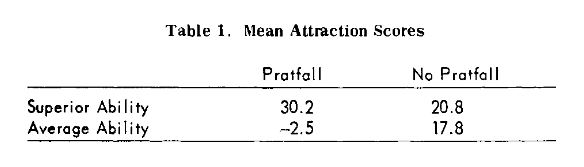

 
As hypothesized, an individual presenting himself with a high intellect was seen as more likeable when having spilled the coffee. Was Jones' clumsiness 'premeditated'? On one hand it might seem unlikely given his overall narcissistic behavior, on the other hand 'abusing' the pratfall effect would fit into his manipulatory repertoire. Voluntary or not, the effect remains the same as the audience's laughter gains an almost hysterically relieved tone, conveying the lines: 'He is not only the prophet we have been waiting for but, more importantly, he is also human.'


References:

Aronson, E., Willerman, B., & Floyd, J. (1966). The effect of a pratfall on increasing interpersonal attractiveness. Psychonomic Science, 4, 227-228.

Batson, C. D., Duncan, B. D., Ackerman, P., Buckley, T., & Birch, K. (1981). Is empathic emotion a source of altruistic motivation? Journal of Personality and Social Psychology, 40, 290-302. 

Berscheid, E., & Walster, E. (1969). Interpersonal attraction. Reading, MA: Addison-Wesley.

Byrne, D. (1971) The Attraction Paradigm. New York: Academic Press.

Cialdini, R. B. (2007). Influence: The Psychology of Persuasion. New York: HarperCollins.

Goffman, E. (1961). Asylums: essays on the social situation of mental patients and other inmates. New York: Anchor Books.

Regan, D. T. (1971). Effect of a favor and liking on compliance. Journal of Experimental Social Psychology, 7, 627-639.

Schwartz, B. (1967). The Social Psychology of the Gift. American Journal of Sociology, 73, 1-11.
 

The power of the in-group: Similarity and compliance

We're all Canadian, so make sure you drink our Canadian beer!


But why is it that this type of advertising is effective?

The presence of groups is the underlying basis for much of our social cognition, and indeed it has been suggested that groups play such an important role in our processing that this may be the reason for the relatively large size of the neocortex in humans – to allow for the maintenance of more social relationships (Dunbar, 1992).

If groups play such an important role in our social processing, we can expect their presence to have some visible effect on human behaviour.

A key aspect which ties members of an in-group together is similarity: people who are similar to one another will consider themselves as part of an in-group. Burger, Messian, Patel, Prado and Anderson (2004) investigated the relationship between perceived similarity and compliance to a request:

They first demonstrated the effect that even relatively meaningless similarities can have, showing an increased compliance to a request if the person asking and the person receiving the request shared the same first name. This is an effect known as the minimal group paradigm, something which truly emphasises the power of the in-group as the nature of the group does not have to be important – even trivial similarities can cause an in-group bias which can lead to increased compliance.

Figure 1 shows the percentage of participants who complied to a request when they either did or did not share the same first name as the confederate

As well as demonstrating an in-group bias for trivial similarities, Burger et al (2004) showed an even stronger effect on compliance when the similarity is uncommon – something similar between two people that not many other people share. In the study, participants were in one of three conditions: a control condition, a common similarity condition – in which they were told they shared a fingerprint type with the confederate, that around 80% of the population had – or the uncommon similarity condition – in which the fingerprint type they supposedly shared was only present in 2% of the population.

Figure 2 shows the percentage of participant's who complied to a request in each of the experimental conditions

In both experiments, the request made was for the participant to read an eight-page essay and provide a page of written feedback – not exactly a small ask! Therefore, the compliance rates seen in some of the similarity conditions – 82% for an uncommon similarity – shows the robustness of the effect, and the role that similarity and in-group bias plays in our everyday decision making.

So, next time you want your colleague to cover a shift, make sure you first illustrate some common ground between the two of you – especially if you can think of some unique similarities – in order to enforce a real sense of an in-group!

References:
Burger, J. M., Messian, N., Patel, S., del Prado, A., & Anderson, C. (2004). What a coincidence! The effects of incidental similarity on compliance.Personality and Social Psychology Bulletin30(1), 35-43.

Dunbar, R. I. (1992). Neocortex size as a constraint on group size in primates. Journal of Human Evolution22(6), 469-493.

You ain’t nothin' but a hound dog...If you don’t buy my album: The impact of social proof

The principle of social proof states that, when making a decision, individuals analyse the behaviours of others to determine what is and what is not appropriate in any given situation. We look to others to confirm our behaviours, thoughts, beliefs and values. If a substantial amount of other people are thinking or behaving in a way which is similar to our own thoughts and behaviours, then our own thoughts and behaviours are validated. However, if the thoughts and behaviours of others are divergent from our own then we are motivated to act as the majority does, with the assumption that the majority must be correct (Kelman, 1958).

The technique of social proof has been widely utilised in advertising for many decades. The example below, of Elvis’s 9th album cover, released in in 1959, is an instance of the use of the social proof principle. It attempts to persuade individuals to purchase the album by playing on the fact that Elvis had (by 1959) sold approximately 50,000,000 albums worldwide. This makes individuals want to purchase the album under the assumption that other people’s behaviour is indicative of the ‘correct’ behaviour; as the album itself states “50,000,000 fans can’t be wrong”. 


The technique of social proof is still widely used in the modern era. For instance, social proof is heavily integrated into modern technology. Take this blog for instance, the number of page views this blog has received is displayed on the right-hand panel. Given the vast number of views the blog has received, it signals to you, the reader (rightly, or wrongly), that this blog is a valuable and suitable source of information. After all over 400,000 people have used it so far, right? Surely the judgement of 400,000+ individuals couldn’t possibly be wrong? This is the ‘logic’ that underlies the effectiveness of social proof.

Cialdini, Wosinska, Barrett, Butner and Gornik-Durose (2010) found evidence of the effectiveness of social proof in gaining participation to a request. The researchers asked students (from both the USA and Poland) to imagine that they were approached by a representative of ‘Coca Cola’, then asked to sample the product, and finally asked to complete a questionnaire about the product which would take approximately forty minutes.

Participants were required to indicate their likelihood of completing the request under different conditions of social proof (SP), on a scale from 0 (no intentions to comply with the request) to 8 (very high likelihood of completing the request).

First participants were asked to indicate the likelihood that they would complete the survey, having been told that all their classmates in the past had complied with the request (high intensity SP condition). Then, at a later date, the same people were asked to indicate the likelihood that they would comply with the request, with the knowledge that approximately half of their classmates had agreed to complete the request (moderate intensity SP condition). Finally, the participants were asked how likely they were to complete the request with the knowledge that none of their classmates had completed the request (low intensity SP condition).

The participants (both from the USA and Poland) were significantly more likely to comply with the request when they were told that all, or half, of their classmates had complied, compared with when they were told that none of their classmates had complied previously. These results are displayed in the graph below. The authors conclude that social proof led participants to believe that agreeing to the request was the ‘correct’ behaviour in the situation, compelling them to complete the request themselves, out of a desire to behave in the ‘correct’ way. 


References
Cialdini, R. B., Wosinska, W., Barrett, D. W., Butner, J., & Gornik-Durose, M. (1999). Compliance with a request in two cultures: The differential influence of social proof and commitment/consistency on collectivists and individualists. Personality and Social Psychology Bulletin, 25, 1242-1253.
Kelman, H. C. (1958). Compliance, identification, and internalization: Three processes of attitude change. Journal of Conflict Resolution, 2, 51-60.


Guilt tripping: Liking isn’t helping


This is an advert from a campaign series by Publicis Singapore for Crisis Relief called ‘Liking isn’t helping’. Crisis Relief is a Christian disaster relief organisation that aims to encourage volunteers to help in crises around the world, with its “Be a volunteer. Change a life” tagline. This particular advert, one of three in the campaign, contains a real press image entitled ‘War’, with a mother holding her injured child in her arms. Surrounding this scene are a number of thumbs ups, to represent the use of the ‘like’ button on the social networking site Facebook.

The advert plays on the emotions of the individual viewing it and is an example of invoking guilt as a means of persuasion. It highlights the fact that a simple click of the ‘like’ button on Facebook will not actually help the pain and grief suffered by the victims of these crises. It is in this way that Publicis Singapore hopes to encourage the individuals to become volunteers to help in these situations, as those who experience guilt are often motivated to try and alleviate the feeling, often through prosocial behaviour. For example Regan, Williams and Sparling (1972) found that inducing guilt in women by making them believe they had broken a camera, later resulted in them helping an indivudal with a broken grocery bag. More importantly in this case, it has also been shown that guilt is associated with an individual's intention to donate to charity (Hibbert, Smith, Davies & Ireland, 2007).

In terms of guilt and volunteering behaviour, Yinon, Bizman, Cohen and Segev (1976) investigated whether inducing different levels of guilt would affect what level of volunteering participants were willing to carry out. Participants were either given a low-guilt, moderate-guilt or high-guilt inducing leaflet about the fact they had not already volunteered for the civil guard. A control group did not receive any leaflet and therefore no guilt was induced with this group. After reading the leaflets, participants were given a list of six alternative amounts of volunteering for the civil guard, ranging from a high level of volunteering, to refusal to volunteer. The results showed a curvilinear relationship between the level of guilt induced and the level of volunteering chosen. Those who had received the moderate-guilt leaflet were most willing to do more volunteering for the civil guard, compared to the no-guilt, low-guilt and high-guilt groups (see Table 1).

Table 1. Means* and standard deviations of amount of volunteering to civil guard according to the experimental conditions
*Note: the higher the number, the less volunteering
This research shows how inducing guilt can influence an individuals' volunteering behaviour. Therefore, the Crisis Relief advert guilt to make the indiviudal question why they are liking the image on social media instead of helping the cause. This may consequently motivate them to volunteer in such crises.

References:

Hibbert, S., Smith, A., Davies, A., & Ireland, F. (2007). Guilt appeals: Persuasion knowledge and charitable giving, Psychology and Marketing, 24, 723-742.
Regan, D. T., Williams, M., & Sparling, S. (1972). Voluntary expiation of guilt: A field experiment, Journal of Personality and Social Psychology, 24, 42-45.
Yinon, Y., Bizman, A., Cohen, S., & Segev, A. (1976). Effects of guilt-arousal communications on volunteering to the civil guard: A field experiement, Bulletin of the Psychonomic Society, 7, 493-494.


What Feeds The Trolls?: The Online Disinhibition Effect

Trolling is rife online, particularly it appears on anonymous websites where the perpetrators are almost completely unidentifiable. Negative trolls are defined as individuals who deliberately engage in damaging and disruptive behaviour online, such as online vandalism and cyberbullying (Phillips, 2011). While these comments may only be made online, they nonetheless can have devastating consequences offline, in the real-world. Over the years, there have been several people who have taken their own lives after being a victim of internet trolls.
One example is Hannah Smith (14) who took her own life in 2013 after she received dozens of abusive messages on Ask.fm, a website where users are able to comment anonymously on others profiles. Additional cases include Jessica Laney (16) and Izzy Dix (14) who were also sent cruel messages on Ask.fm before committing suicide.
Trolled: Some of the messages sent to Hannah Smith before she died.

Some researchers have investigated whether the degree of identifiability influences commenting behaviour online. For instance, people may be more likely to make offensive comments when they are less identifiable because the increased anonymity, decreases inhibition (Suler, 2006). This is known as the online disinhibition effect.

Subsequently, Cho and Acquisti (2013) proposed that the degree of identity disclosure may be a vital factor in influencing online commenting behaviours. The researchers analysed a social commenting system where the users could choose one of three types of accounts; (1) non-social-network site (SNS) account; (2) a pseudonym SNS account (e.g. twitter); or (3) a real name SNS account (e.g. facebook). The real name SNS account has the highest level of identifiability, while the non-SNS account provides the least amount of information about the user's identity. Thus, Cho and Acquisti (2013) hypothesised that those who choose the non-SNS account are more likely to use offensive words.

The findings supported their hypothesis and showed that those choosing to use a real name SNS account were less likely to use offensive language, while those who used a non-SNS account were more likely.


Figure 1: Proportion of the Use of Offensive Words by Account Type Each Week


Figure 2: Proportion of the Use of Offensive Words by the Use of Real Name


Both figures show that the use of SNS accounts and the disclosure of the user's real name are less likely to be correlated to the use of offensive words. Whereas, the greater anonymity associated with non-SNS accounts increases the likelihood that the user will post comments containing offensive language. Therefore, this suggests that the degree of identifiability does influence commenting behaviour online; the greater the anonymity, greater the effect of online disinhibition.

Consequently, should there be greater regulation of websites, such as Ask.fm, that allow people to comment anonymously? Should there be a policy in place where the person must at least provide their real name before being allowed to comment? If such policies were to be enforced, perhaps there would be fewer instances of negative trolling and online abuse.


References:
   Cho, D., & Acquisti, A. (2013). The More Social Cues, The Less Trolling? An Empirical Study of Online Commenting Behavior. Unpublished manuscript, Carnegie Mellon University, Pennsylvania, PA: United States.
   Phillips, W. (2011). LOLing at tragedy: Facebook trolls, memorial pages and resistance to grief online. First Monday, 16(12).
    Suler, J. (2004). The online disinhibition effect. Cyberpsychology & behavior,7(3), 321-326.

You Won’t Believe What He Says About Clickbait in This Article.

Over the last few years, we've all been at the mercy of hyperlinked article titles along the lines of, ‘This is the best news story ever!’ or ‘You’ll be astounded by what she says about these four superfoods’. In fact I can image most people sighing with resignation at the mere format of the title of this post. It’s a common sight to see these sorts of headlines primarily on the articles of Buzzfeed and the Huffington post, but also on the websites of the Washington post and the New York Times.


In the literature this sort of title is labelled as forward-referencing, (Blom & Hansen, 2015).  In that the title refers to information yet to be disclosed. It is typical for a forward-referencing title to reveal little of the content necessary to gain an understanding of the key message in the article. It is important to understand two key ideas surrounding clickbait headlines, first of all the situation that created the need for them, and then the process behind them.

Blom and Hansen, (2015), conducted a study investigating Danish newspapers online pages, and primarily investigated the sorts of situations in which these headlines typically arise. They found that forward-referencing headlines were most common in commercial media without paywalls, which rely on ad revenue to make money. They argue that with people able to read an informative headline and move on, the page would receive a lower viewership and ad revenue will decrease, as typically clicks or ‘taps’ are used to measure the traffic on a webpage and determine how many people an advertisement will have access to.

Additionally they found that these headlines tended to feature in ‘news soft’ topics, namely lifestyle and Gadget themed articles, as demonstrated by figure 1. The difference between forward-referring headlines in hard news (News) and soft news (Sport, weather, lifestyle and Gadget) is statistically significant at the p < 0.01 level.


Figure 1. Percentage of forward-referring headlines in the preliminary data set from tv2.dk (Blom and Hansen, 2015).

So while the need for some way of enticing people to not simply read the headline, but to click on the link to the actual web page, to allow the adverts to reach their audiences, what is it about forward-reference headlines that fulfil this role. Well, in their thesis, Claessens, (2015), argues that clickbait headlines utilise the curiosity inducing information gap coined by Loewenstein, (1994), and build upon in the paper by Golman & Loewenstein, (2014). The theory states that curiosity results from an information gap, defined as the gap between what one knows and what one would like to know. We as people are motivated to close this gap by experiencing high levels of curiosity when the gap is small, and therefore easily attainable.

This is utilised by forward-reference headlines by making a statement that creates this information gap, arouses curiosity which can only be satisfied by simply clicking the headline, and creating discomfort if we do not. While the research into whether clickbait headlined articles actually receive more page views has yet to be conducted, the groundwork for why we have to put up with those annoying adverts and links is there, and if as suggested more people do indeed click on them to satisfy that itching curiosity about those ‘seven easy organising tricks you’ll actually want to try’, then it looks as if they’ll be around to stay.

References
Blom, J. N., & Hansen, K. R. (2015). Click bait: Forward-reference as lure in online news headlines. Journal of Pragmatics, 76, 87-100.
Claessens, M., & (2015). Curiosity-inducing Communication: Hazardous Lure or Effective Motivator? Economic, M. A.
Golman, R., & Loewenstein, G. (2014). Curiosity, Information Gaps, and the Utility of Knowledge. Information Gaps, and the Utility of Knowledge (March 30, 2014).
Loewenstein, G. (1994). The psychology of curiosity: A review and reinterpretation. Psychological bulletin, 116(1), 75.


Like a shot in the arm: inoculation theory applied to student credit card debt attitudes

The denial of scientific research can have dramatic consequences.

Sure, denying the existence of the dinosaurs or arguing that the Earth isn't round isn't going to kill anyone (unless you decide to sail off the edge of it), but denial of the effectiveness of vaccines because it is believed that they cause autism is causing a rise in the number of preventable diseases.


When we present evidence that contradicts someone's beliefs, that someone's beliefs may grow even stronger. When proving that vaccines aren't linked to autism, anti-vaxxers express their belief even more strongly. The same occurs with the idea that humans are causing climate change; presenting more evidence can lead more people to believe the contrary.


The famous facepalm

Inoculation

To  neutralise misinformation found in misconceptions like "there is no such thing as global warming", one should make use of inoculation theory. This theory applies inoculation, often associated with vaccines, to knowledge. First developed by McGuire in 1961, inoculation theory helps us to preserve our original attitudes and beliefs in the face of persuasion. Just like a shot in the arm uses weakened or dead viruses that stimulates our immune system to protect against future attacks, an inoculation uses a weakened version of a future persuasion attempt.

inoculation applied to drugs


Research on inoculation

The theory has been replicated widely, being used in politics, PR, and smoking and drinking prevention. Recognizing a serious problem with student credit card debt, and with no clear way to solve this (at the time), Compton & Pfau (2004) tested whether inoculation theory would extend to students under attack from credit card marketing.

Compton & Pfau set out their inoculation in 3 phases:

1) Participants were assessed whether or not they had a credit card and their attitude towards credit cards.

2) Their attitudes towards credit cards were assessed again, followed by an inoculation message.

3) Participants were then subjected to a simulated credit card advertising message, then again were assessed on their attitudes towards credit cards

Results

Inoculation helped to defend against credit card advertisements, with students protecting healthy attitudes about credit cards (table below). Students were also more likely to pay-down their credit card debts if they had them, whilst word-of-mouth communication towards their peers about attitudes related to credit cards increased. 


How does it work?

Inoculation works by engaging the central route of processing an attitude. The inoculation message's weak attack causes the person to think carefully, unlike peripheral processing in which people bypass the whole thinking part. Inoculation causes people to think more than they would otherwise. This thinking develops stronger attitudes about an object, in the above case; attitudes about credit card use, and this will lead to a behaviour change (as the picture below shows).


So if you want to succeed in inoculating people against those pesky credit card companies, or against any cold-calling companies then it'll be good to follow these three rules:

1. Warn the person of an impending persuasive attack
2. Make a weak attack (inoculation message; not too strong, not too weak)
3. Have the person defend their attitude 

References

Compton, J. A., & Pfau, M. (2004). Use of inoculation to foster resistance to credit card marketing targeting college students. Journal of Applied Communication Research, 32, 343-364.

McGuire, W. J., & Papageorgis, D. (1961). The relative efficacy of various types of prior belief-defense in producing immunity against persuasion.The Journal of Abnormal and Social Psychology62, 327.